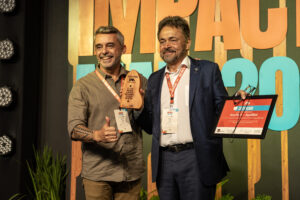

Belém (Brazil), November 10, 2025 — The AçaíBot, the world’s first robotic harvester for açaí, developed by the Amazon-based company Kaatech, was presented on Monday (10) during the opening session of COP30 in Belém, Brazil.
The presentation took place at the CAIXA Space (CAIXA Arena), with the support of Caixa Econômica Federal, bringing together Indigenous leaders, family farmers, and representatives from national and international institutions to discuss innovation and sustainable development in the Amazon.
The session, titled “AçaíBot: Technology in Açaí Harvesting — How to Democratize Access to Safe Harvesting Technology through PRONAF-B”, was led by João Rezende, Commercial Director at Kaatech, who introduced the AçaíBot as a symbol of the new Amazonian bioeconomy.
“AçaíBot is more than technology — it represents social, environmental, and economic evolution. It shows that the Amazon can generate innovation with sovereignty, creating income while keeping the forest standing,” said João Rezende during the opening panel.
Technology developed in the Amazon
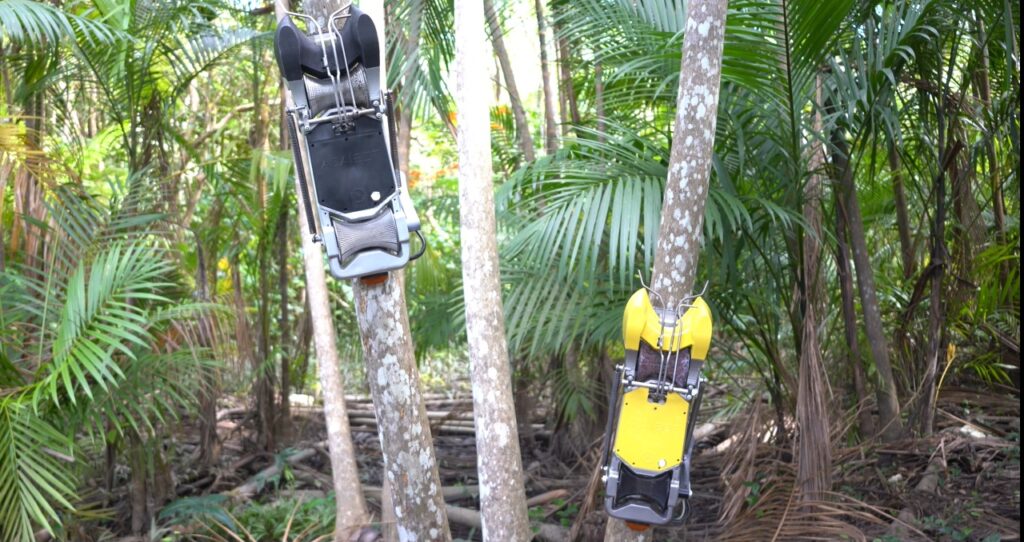
Designed and patented in Belém, Pará, the AçaíBot is a 100% Brazilian innovation created to modernize family farming in the Amazon.
The robot weighs just 8 kilograms (17 lbs), operates for up to four hours, and can climb and harvest an açaí bunch in under one minute. Built with reinforced polymers and integrating mechanical, electrical, and embedded software systems, it is lightweight, durable, and adapted to the floodplain environment of the rainforest.
By replacing the traditional “peconha” climbing method — a manual and hazardous technique still responsible for serious accidents and child labor — the AçaíBot offers safety, inclusion, and efficiency, enabling women and young people to take part in a productive and dignified work process.
Social and environmental impact
Beyond its technical innovation, the AçaíBot drives measurable improvements in income, education, and sustainability for Amazonian communities.
According to Kaatech’s report, each unit achieves a productivity rate above 900 kg (1,980 lbs) per day, ensures financial payback in under two months, and can generate annual household income of up to R$ 300,000 (USD 55,000).
The project directly contributes to nine United Nations Sustainable Development Goals (SDGs):
- SDG 1 – No Poverty: Annual family income up to R$ 300,000;
- SDG 2 – Zero Hunger: Productivity between 243–360 kg/day;
- SDG 5 – Gender Equality: Women trained as AçaíBot operators;
- SDG 8 – Decent Work and Economic Growth: Elimination of child labor and creation of 2,000 new jobs;
- SDG 9 – Industry, Innovation, and Infrastructure: 100% Brazilian-made patented technology;
- SDG 10 – Reduced Inequalities: Access extended to riverine, Indigenous, and quilombola communities;
- SDG 12 – Responsible Production and Consumption: Increase in fruit utilization from 10% to 70%;
- SDG 13 – Climate Action: Sequestration of 70–85 tCO₂e per hectare, generating REDD+ carbon credits;
- SDG 15 – Life on Land: Protection of up to 500,000 hectares of Amazon rainforestacaibot relatorio ods.
Support from Caixa and financing through PRONAF-B
During the event, Rezende presented a financing model through PRONAF-B, Brazil’s national program for family agriculture, designed to make AçaíBot technology accessible to small producers and traditional communities.
The initiative is supported by Caixa Econômica Federal, reinforcing the institution’s commitment to projects that unite innovation, social inclusion, and forest conservation.
Indigenous leaders participating in the session emphasized that the AçaíBot represents economic autonomy and dignity for their communities — a way to generate income without deforestation while valuing ancestral knowledge and sustainable forest management.
A symbol of the Amazon bioeconomy at COP30
Presented during the opening of COP30, the AçaíBot stood out as one of the most emblematic symbols of the Amazonian bioeconomy.
The project is aligned with Brazil’s National Bioeconomy Initiative, launched at the G20 in 2024, and supports the country’s commitment to achieving zero deforestation by 2030.
By connecting technology, social development, and climate action, the AçaíBot demonstrates that the Amazon can lead a global model of green and inclusive growth.
About Kaatech
Kaatech is an Amazon-based technology company headquartered in Belém, Pará (Brazil), dedicated to developing sustainable solutions for family farming and the bioeconomy.
Creator of the AçaíBot, the world’s first robotic harvester for açaí, Kaatech focuses on social inclusion, environmental preservation, and income generation for Amazonian communities.
Informações à imprensa:
Assessoria de Comunicação Grupo KAA
Marcos Horostecki
48-998295320
📧 comunicacao@acaikaa.com.br
| 🌐 www.kaatech.com.br